Monday, February 24, 2014

Felted Slippers


This past weekend Laughing Coyote hosted a Slipper Felting Workshop with Margaret Tullis. I was lucky enough to be able to be a participant and came out of the two day workshop with a wonderful and perfectly fitting pair of handmade woolen slippers. This was the first time Laughing Coyote has offered a slipper felting class and from my experience it was a huge success. Margaret was a wonderful and methodical teacher, taking the class through the soap felting process step by step and the last day we learned embroidery and beading techniques to decorate our slippers, to make them unique, as well as how to patch holes or thin spots. Soap felting is an absolutely magical process, to go from light fluffy roving to dense and foot-shaped felt takes some serious time, elbow grease and patience, but in the end the satisfying feeling of accomplishment is overwhelming. I am now waiting for my slippers to dry (which takes only a few days here in dry Colorado). Meanwhile I am designing my embellishment and will add a photo of my finished slippers soon. Hope you can join us next time! 
~Gelsey
Colored roving that one of the students picked out

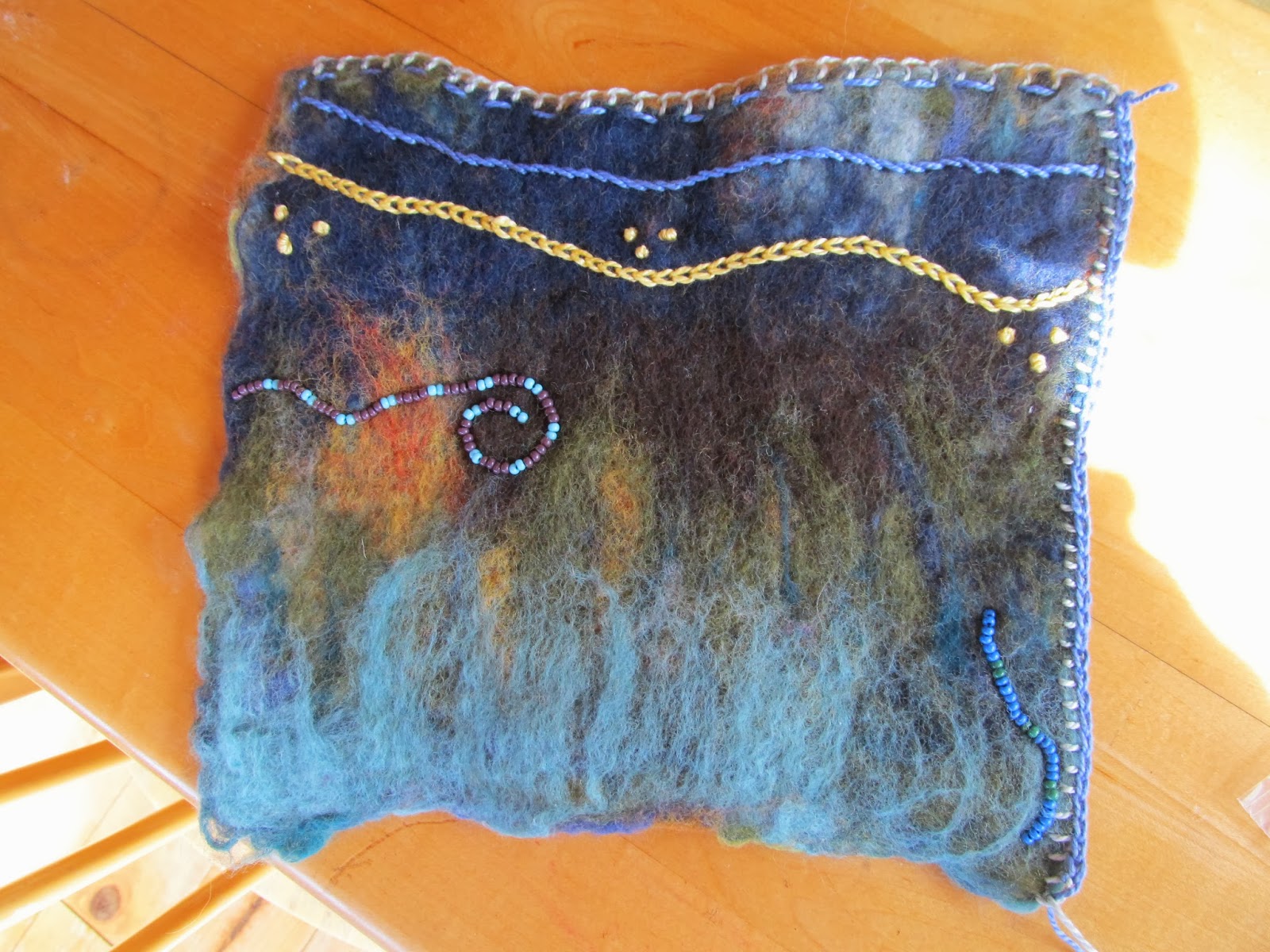
Laying out my swatch which later I embroidered

Starting to felt my swatch

Roving colors I chose for my slippers

Plastic slipper pattern

The first layer

One of the students' colorful embellishments

Patting, soaping and adding hot water to begin the felting process

I can't believe that this big hunk later turned into a beautiful slipper

Felting on my foot

A finished slipper and a "raw" slipper

Finished! But they still need to dry

The class' colorful slippers

Unique and colorful

Lovely ladies!

Embroidery, beading, and finishing techniques

Close up

The daisy stitch and more

Tuesday, January 21, 2014

Skills Series at Jax

Sam Ritter, our long-time instructor, is running a series of classes at Jax Mercantile in Lafayette, CO. If you are interested, contact him directly at sam@laughingcoyotproject.org.


February 9 — Primitive Fire, 9am - 3pm
 
February 16 — Primitive Hunting, 9am - 3pm
 
February 23 — Primitive Traps, 9am - Noon

Wednesday, January 15, 2014

BOSS Field Course


Our instructor Galen Stanger wrote this post about his experience over the summer at Boulder Outdoor Survival School's 14 day Field Course. Enjoy!


At the end of this past summer I spent 2 weeks living in nature. I took a 14-day Boulder Outdoor Survival School (BOSS) course in Utah. There were 12 of us - 9 students and 3 instructors. We only had a couple of items the first three days, to simulate a true survival situation. I had a water bottle, two wool upper body layers, wool pants, a hat, and a knife. We walked 27 miles in the first three days. It’s amazing what the body can do with no food and only water. There were some things to forage alone the way but if the body does not get 500 calories in one day it’s better not to eat anything. After 3 days of walking and no food, it was about 11:00 at night and we came to a primitive camp with Wikiups. I ate the best tasting banana I had ever had in my life, and went to bed for a much needed sleep in the Wikiup with a wool blanket. The nights were getting cold, down into the 30ยบ’s.

This was the transition from surviving in the natural world to living in the natural world. In order to sustain ourselves, we took the life of an animal in a very humane and humbling way. There were two days spent processing every part of this animal in honor of its life so we could stay alive and continue on our journey. We took care of camp chores and prepared for our travels as we still had a long way to go. The way got easier even with small blanket packs carrying a little food, two water bottles, and my wool layers. The guidance of our route was handed over to us. We were given maps and an end destination. We were to appoint two leaders for a day but any of us students could weigh in on the route we traveled. We set out from the primitive camp out of the canyon and headed up to 11,000 feet, mountain country. After a couple of days in the mountains and getting rained on we headed back to the desert. It had been 8 days and at this point our instructors had shown us everything they could. It was time for our solos. Three days by ourselves alone for some solo time and living in the natural world with almost nothing.

 After a great three days the group came back together. This led to the next stage where our instructors left us for 2 days. We had an end destination and a route led by us with no instructors. We had been a group for 12 days, so this was our time to sink or swim. It was inspiring to be in that group. From the slowest person to the fastest we all picked each other up when we fell. There were many leaders but we took turns never stepping on each other’s feet and always looking out for the welfare of the group. After a wonderful two days, and seeing the best looking little creek in my life (because I hadn't seen water deep enough to submerge in for two weeks), we met back up with our instructors at sundown of the second day. We told our stories of the last two days and set off on our final challenge, which as a BOSS tradition, I can’t say what it was. Every one of us made it the whole 100 miles in two weeks.  We ate a great final breakfast together back at base camp. Finally something more than the 3 items that had been on the menu for the past two weeks.

There is something to be said about simplicity, and living in the natural world with no protection. I have come back a changed man in more ways than one. It was an experience I am truly grateful for. Now I have the skill set to survive anywhere, and not just the knowledge.  

~Galen


Crossing through sage

A debris bed, used to insulate us from the ground at night

A wickiup

Drying sheep jerky

One of our instructors in a debris hut
My blanket pack

Poncho-shelter
Woodrat tracks

Testing out a debris bed


My cooking fire on my three day solo


Walking along the canyons

The group at the end of the course

Monday, December 30, 2013

Paleo Xacto Knife

We were lucky enough to have local flintknapper and musician Doug Dahl come out to teach our homeschool group his "Paleo Xacto" knife. Students learned how to use stone spokeshaves and hand held drills to make a slick hafting system for small stone blades and flakes. Doug is a long-time instructor at primitive skills gatherings, and he can be found telling stories and instigating music around many a fire, along with passing on his infectious enthusiasm for ancient skills and artifacts.
~Neal


Doug instructing the group

Some of Doug's work

Using a stone spokeshave


The debarked handle, and antler for compression bead

Using a stone drill

The drilled bead

Finished Xacto

And another

Finished tool, with two others in the works
The students with their new blades


Wednesday, October 2, 2013

Flood Tracking

In Boulder County, we have had an incredible natural event, floods unlike anything we have experienced in the area. The destruction is mind-blowing, and many places I know well are permanently changed by the waters. We have been thinking about all of the people affected by the deluge, and our hearts go out to them. It is a beautiful thing to see community come together in challenging times.

For a tracker, the floods brought in a unexpected element: mud, silt and sand everywhere! In our area, clear tracks are limited to small areas, but suddenly tracks are everywhere. I encourage anyone in the Boulder area to look up from the chaos for a moment, and look at the signs of life everywhere. In downtown Boulder, I saw raccoon tracks everywhere there was mud. (In Behavior of North American Mammals, by Elbroch and Rinehart, they state that suburban and urban raccoon population densities can reach 120-250 animals per square mile. Up until now I found that hard to believe.) At our Primitive Camp, we came across bear tracks and perfect woodrats. While scouting out a hunting location, I saw bear, coyote, wild turkey, raccoon and deer. Some of my favorites are toad and salamander tracks that appeared in the moist conditions. I wish there were more pictures, but I am a little camera-challenged, so they did not all come out. Enjoy some of the pictures, and good luck to everyone on the raod to recovery.

~Neal

Beautiful bear hind foot.


Bear trail.

Check out the claw marks!

Woodrat

Close up of woodrat hind foot.

TOADS! My current favorite tracks.

Crazy toad activity.


Saturday, September 21, 2013

Willow Basket: A visual how-to

This Summer I made several Willow Baskets. Willow is one of my favorite materials to work with for basketry. I took pictures of each step in the process. The willow I used for this basket is from a basketry friend who gathered the willow in California and Utah. One of the most challenging aspects of making willow baskets in dry Colorado is having a large enough body of water to soak the willing in before and during weaving. Since I don't have a pond, I found that a large stock tank works pretty well. Last Winter I found an amazing place to gather willow in Colorado and I look forward to working with Colorado Willow for my next basket.
Enjoy the photos. 
~Gelsey
Starting the base


The first weavers


Constantly soaking!


Adding the spokes into the base

Bringing up the sides


In this basket, I added an "open twined" section


Completed basket


Thursday, August 15, 2013

Animal Processing Article

Wendy Petty, our wonderful Foraging Class instructor, attended the Animal Processing class in June. Here is an article she wrote about her experience:

http://zesterdaily.com/cooking/animal-processing-taps-deep-human-emotion/

Enjoy!